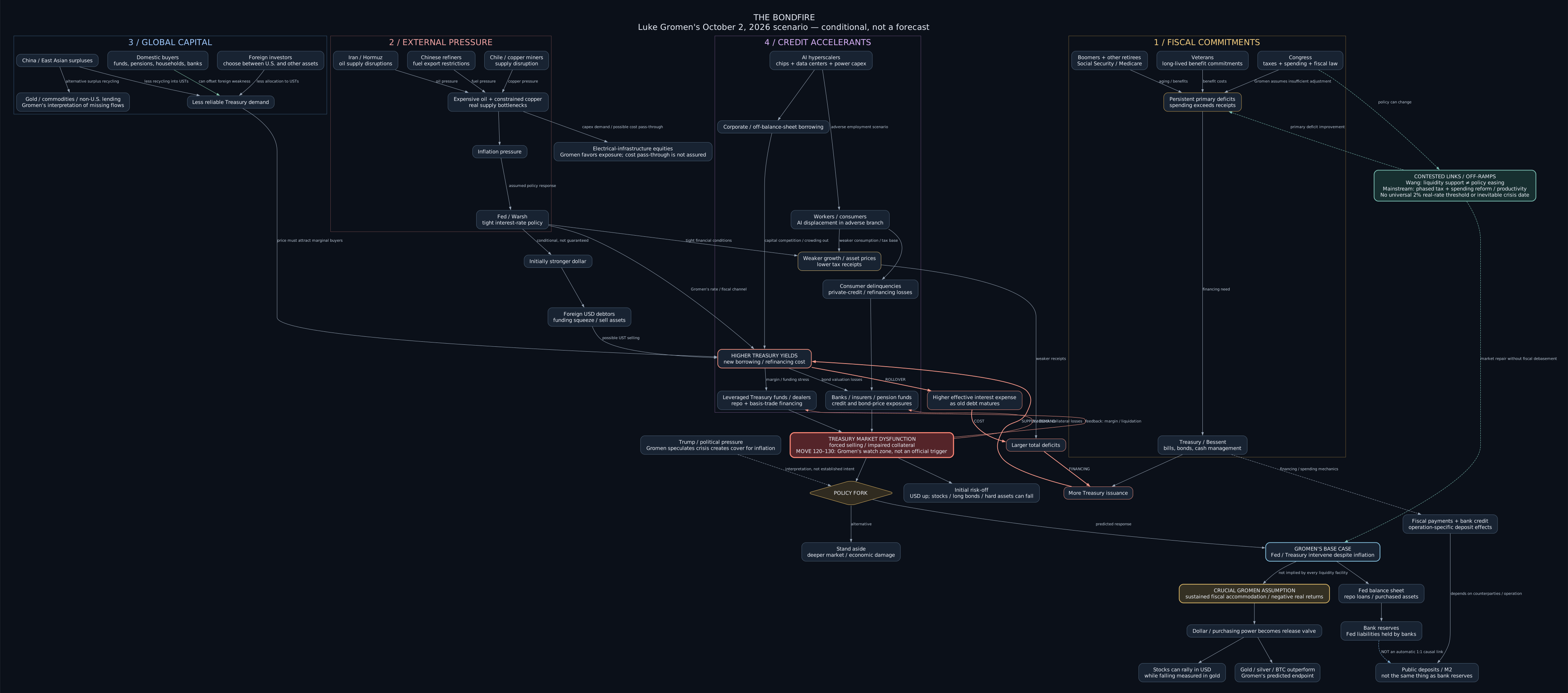
THE BONDFIRE
What if fighting inflation makes the government's debt problem worse?
In Luke Gromen's scenario, Congress, retirees, banks, foreign investors, and geopolitical rivals all feed one combustible system.
This is his October second thesis, dramatized. The explosion is a metaphor, not a forecast.
01 / THE PROMISES
Start with aging boomers and other retirees. Social Security and health care create persistent spending commitments.
Congress controls taxes and spending. Gromen assumes it cannot deliver enough politically acceptable adjustment.
Treasury, led in this scenario by Bessent, must finance the gap with bills and bonds.
As old debt matures, higher borrowing costs lift interest expense. Veterans' benefits add another long-lived commitment.
02 / THE MISSING BUYERS
Foreign investors still buy American assets, but Gromen sees less reliable demand for Treasury bonds.
He interprets China's surplus recycling as shifting toward gold, commodities, and lending outside the United States.
A stronger dollar squeezes foreign dollar borrowers. They may sell American assets to obtain cash.
Domestic investors can absorb more debt, but potentially only at higher yields. Missing foreign flows do not literally mean no buyers.
03 / THE SUPPLY SQUEEZE
Iran and Hormuz disruptions keep oil expensive in Gromen's account. China's fuel export restrictions add pressure.
Chile's copper disruptions constrain another essential input. Electrical infrastructure and the A I buildout need real materials.
The Fed responds to inflation by keeping policy tight. Gromen fears higher yields will worsen fiscal stress.
Oil does not mechanically raise real yields. That link depends on inflation expectations and the Fed's response.
04 / THE SELF-FEEDING LOOP
Higher yields raise refinancing costs.
Higher interest expense widens deficits.
Bigger deficits require more issuance.
More issuance and reluctant buyers put pressure on yields again.
Meanwhile, tighter conditions weaken growth and tax receipts. Gromen calls this a debt spiral.
He treats real rates above roughly two percent as dangerous. It is not an established universal crisis threshold.
05 / THE CREDIT ACCELERANT
A I hyperscalers borrow heavily for data centers, chips, and power. They compete for capital with other borrowers.
In Gromen's adverse scenario, automation also displaces workers, weakening consumption and the tax base.
Consumer delinquencies and corporate refinancing stress damage banks and private credit.
Banks and leveraged Treasury investors now face both funding pressure and falling collateral values. This is a scenario, not an inevitable A I outcome.
06 / THE BREAKING POINT
First, the dollar rises while stocks, long bonds, and even gold or Bitcoin can sell off.
Gromen watches Treasury volatility, the MOVE index around one hundred twenty to one hundred thirty, for dysfunction.
Funding stress meets forced selling. The collateral engine breaks.
The Fed faces his dramatic choice: tolerate deeper disruption, or intervene despite above-target inflation.
07 / THE RELEASE VALVE
Gromen expects the Fed and Treasury to intervene. Bessent can alter issuance; the Fed can supply financing or purchase assets.
Fed lending or purchases expand its balance sheet and bank reserves. That is not automatically the same as expanding M two.
M two includes public money balances. Bank credit and fiscal payments affect deposits; the final money growth depends on the operation.
His crucial prediction is sustained accommodation of deficits: the dollar becomes the release valve, rather than bond yields.
Gold, silver, and Bitcoin then outperform in his view. Stocks may rally in dollars while losing ground against gold.
08 / WHERE THE STORY CAN CHANGE
Gromen's strong point is political inertia. His leap is treating this particular ending as unavoidable.
Joseph Wang distinguishes liquidity support from monetary easing. The Fed can repair funding markets while keeping policy rates high.
Mainstream alternatives include phased tax increases, spending reform, and productivity growth. These are difficult, not mathematically impossible.
Watch the primary deficit, effective borrowing costs, growth, inflation expectations, and the design of the rescue. Not just one yield or one money chart.